Have you ever spent time setting up a lovely activity for your child… only for them to ignore it completely? Or maybe they play for 30 seconds and then walk away.
It’s frustrating, especially when you’ve put in so much effort.
But here’s something that might surprise you: It’s usually not the activity that’s the problem. It’s how it’s been set up.
The good news? You don’t need more ideas, more toys, or more time.
You just need a simpler approach.
Why Some Activities Get Ignored (Even When You’ve Tried Hard)
If your child isn’t engaging with activities, it’s easy to assume they’re just “not interested.” But more often than not, there’s something else going on.
Here are a few common reasons:
- The setup is too complicated
If it takes you 20 minutes to prepare, it’s often too much for a young child to process. - There are too many choices
A busy play space can overwhelm little brains. - There’s no clear starting point
If a child doesn’t know how to begin, they’re likely to walk away. - The activity doesn’t match their stage
Too easy = boredom. Too hard = frustration. - There’s hidden pressure
Children can sense when we really want them to like something.
👉 A common mistake
Spending too long setting something up and then feeling disappointed when your child doesn’t play with it.
You’re not alone in this. So many parents fall into this trap (myself included!). Read my blog post ‘Why isn’t my child playing with the activity I created’ to gain more of an understanding.
What Makes an Activity Actually Work
When an activity does hold your child’s attention, it usually has a few simple things in common.
It’s:
- Open-ended
There’s no “right” way to play (think blocks, scooping, pretend play) - Visually simple
Not cluttered or overwhelming - Familiar
Uses materials your child already knows - Flexible
Can be used in different ways - Inviting
Sparks curiosity without needing instructions
This is why the simplest setups often work the best.
The “Invitation to Play” Formula (Made Simple)
You may have heard the phrase “invitation to play” before, but it doesn’t need to be complicated or Instagram-worthy. This was the basis for all of my developmental play activities in class – which made them so successful:
1. Choose one idea or focus
For example: scooping, sorting, building, or pretend play
2. Add 2–3 materials max
Keep it minimal – this is key
3. Present it clearly
A tray, mat, or small defined space works really well
4. Add a gentle prompt (optional)
Something like:
- “I wonder what you could build…”
- “Can you help the animals find a home?”
Not instructions, just an invitation.
A simple example
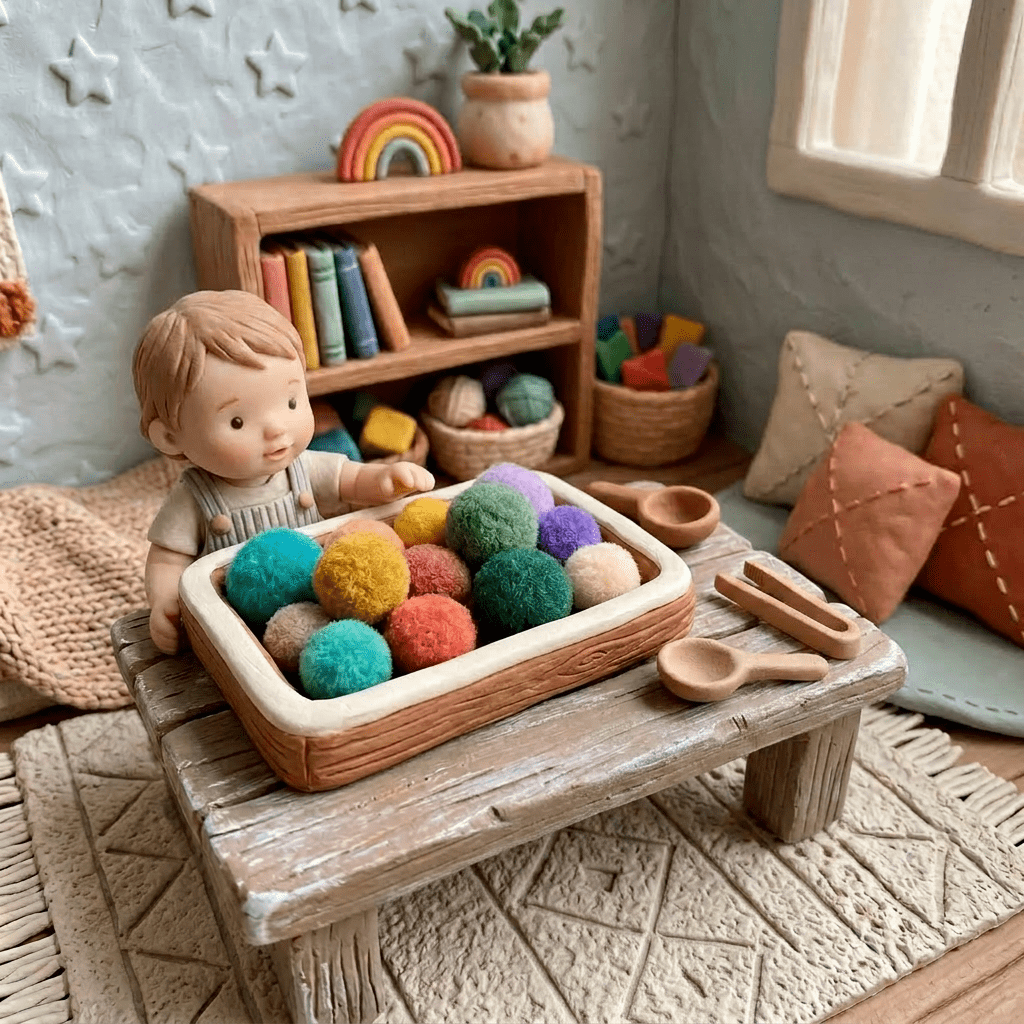
A tray with:
- Pom-poms
- A small bowl
- Tweezers
This kind of setup often holds attention far longer than a complicated craft because your child can immediately see what to do.
How to Encourage Longer Play (Without Stepping In)
Once your child starts playing, the next challenge is: how do you keep them engaged?
It can be tempting to jump in, guide, or extend the play but this can actually interrupt their flow.
Instead, try this:
- Start together briefly
Show them how to begin, then step back - Stay nearby (at first)
Your presence is reassuring - Use neutral language
“I wonder what will happen next…” instead of directing - Avoid correcting or leading
Let them explore freely - Allow a little boredom
This is often where creativity begins
If your goal is to build independent play alongside this, this guide will help:
👉 Tips to Get Your Child to Play Independently (Step-by-Step)
3 Simple Play Setups You Can Try This Week
You don’t need a long list, just a few go-to ideas you can repeat.
1. Scooping & Pouring Station
- Dry rice, pasta, or oats
- Cups, spoons, small containers
- Great for fine motor skills and focus
2. Small World Play
- A few animals or figures
- Blocks or natural materials
- Add a simple prompt like: “Where do they live?”
3. Puzzle or Matching Activity
- Simple puzzles or matching cards
- Keep it familiar and achievable
- Builds confidence and concentration
The key isn’t constantly changing activities. It’s repeating what works.
Children thrive on familiarity and that’s often what leads to longer, more independent play over time.
FAQs
Why won’t my toddler play with activities I set up?
Often it’s because the activity is too complex, unclear, or overwhelming. Simpler setups usually work better. Read my blog here to understand more.
What are easy activities for toddlers at home?
Scooping, pouring, stacking, sorting, and pretend play are all simple and effective. Read my blog here on how to support toddler play at home.
How do I keep my child engaged in play longer?
Start small, keep activities familiar, and avoid interrupting their play once they begin.
Do I need lots of toys for my child to play?
Not at all. Fewer, well-chosen items often lead to deeper play.
A gentle next step
If you’ve been feeling like you need to do more, plan more, or create more… this is your reminder that you really don’t. Simple works.
And when you find the setups that click for your child, everything starts to feel easier.
If you’d like more ideas like this (the kind you can set up in minutes, not hours), I share them each week in my newsletter.
👉 You can join here and I’ll send you a few easy play setups to get started.
Karmal x
🥰Visit my website www.learninglighthouse.net for free resources to help you with easy learning through play activities.
⭐Inside my free Facebook group I share weekly tips and activity ideas designed to help you support your child’s development. Click here to join.
💡Need help with getting your preschooler to grow and thrive at home? My Developmental Activity Cards give you 30 simple play-based activities that support learning in a fun and playful way. I guide you through each activity step by step. Just click on the relevant link below to learn more about each set.
Leave a Reply